faith
Articles (240)
How to Know God
Lincoln Cannon draws on Mormon scripture to explore how God can be known—through intelligence, embodiment, community, and presence throughout the world.
In Memory of Mike Perry
Lincoln Cannon remembers Dr. Mike Perry—a devoted Alcor leader, cryonics pioneer, and religious transhumanist who contributed to the MTA and CTA communities.
29 Thoughts on April 2026 General Conference
Lincoln Cannon reflects on the April 2026 LDS General Conference, reading 29 talks through a transhumanist lens of faith, technology, and transformation.
Postsecular Christian Transhumanism
Lincoln Cannon responds to Comment Magazine, arguing for a postsecular Christian Transhumanism that embraces technology as part of human sanctification.
Carl Youngblood from the Depths
Lincoln Cannon celebrates the launch of Carl Youngblood's blog 'From the Depths,' named for Psalm 130 and exploring faith, doubt, and Mormon thought.
Authors (67)

Athanasius
Athanasius of Alexandria (c. 296–373 AD) was one of the most influential theologians in Christian history, serving as the twentieth Pope of Alexandria and playing a decisive role in the development of Trinitarian doctrine. His lifelong defense of the Nicene Creed against Arianism earned him the title ‘Father of Orthodoxy,’ while his writings on the incarnation articulated a vision of human transformation that continues to resonate in Eastern Orthodox theology and beyond. Born in Alexandria, Egypt, Athanasius received a thorough education in Greek literature, philosophy, and Christian scripture. As a young deacon, he accompanied Bishop Alexander to the Council of Nicaea in 325 AD, where he witnessed the formulation of the creed that would define Christian orthodoxy. Three years later, at approximately thirty years of age, Athanasius succeeded Alexander as bishop of Alexandria—a position he would hold for forty-five years despite being exiled five times by various emperors sympathetic to Arianism. Athanasius ’ s most enduring theological contribution appears in his treatise On the Incarnation , written when he was still a young man. In this work, he articulated the doctrine of theosis—the belief that God became human so that humans might become divine. This concept, sometimes expressed as ‘God became man that man might become god,’ became central to Eastern Orthodox spirituality and has profound implications for understanding human potential and destiny. Throughout his tumultuous career, Athanasius faced opposition from Arian bishops, imperial persecution, and periods of exile in the Egyptian desert, Rome, and elsewhere. Yet he persisted in defending what he understood as apostolic faith against theological compromise. His friendship with the desert monks, including Anthony the Great, influenced his biography of Anthony, which became foundational for Christian monasticism and hagiography. Athanasius’s doctrine of theosis resonates profoundly with transhumanist themes. His vision of humanity’s potential for transformation and participation in divine nature anticipates contemporary discussions of human enhancement and transcendence. The idea that humans are destined for a radical elevation of their nature—not merely moral improvement but ontological transformation—connects ancient Christian theology with modern aspirations for human flourishing beyond current limitations.

Augustine of Hippo
Aurelius Augustinus Hipponensis (354–430), commonly known as Augustine of Hippo or Saint Augustine, was a theologian, philosopher, and Bishop of Hippo Regius in Roman North Africa. He is widely regarded as one of the most influential figures in the development of Western Christianity and Western philosophy. Augustine’s major works include Confessions , a pioneering spiritual autobiography, and The City of God , a monumental defense of Christianity against pagan criticism following the sack of Rome. His theological contributions shaped doctrines on original sin, divine grace, predestination, and the nature of the Trinity. Before his conversion to Christianity, he explored Manichaeism and Neoplatonism, and his synthesis of Christian doctrine with classical philosophy profoundly influenced medieval thought, the Protestant Reformation, and modern philosophy alike. Augustine’s concept of deificatio (divinization) — the idea that humanity is called to participate in the divine nature — resonates with Mormon Transhumanist themes of theosis and the elevation of human potential. His emphasis on humanity’s restless longing for God (“Our hearts are restless until they rest in You”) speaks to a vision of human beings as fundamentally oriented toward transcendence. However, significant tensions exist between Augustine’s theology and Mormon Transhumanist thought. Augustine’s doctrine of original sin and total human depravity, his skepticism of unaided human will, and his emphasis on predestination stand in marked contrast to Latter-day Saint affirmations of human agency, moral capacity, and an optimistic anthropology. Additionally, Augustine’s commitment to creatio ex nihilo and the absolute ontological distinction between Creator and creature diverges from Mormon theology’s more materialist and continuity-oriented understanding of God and humanity. Nevertheless, Augustine’s enduring call to seek wisdom, his insistence that faith and reason are complementary, and his vision of humanity’s ultimate union with the divine ensure his lasting relevance to conversations at the intersection of faith, philosophy, and human flourishing.

B. H. Roberts
Brigham Henry Roberts (1857–1933) was a historian, theologian, and General Authority of The Church of Jesus Christ of Latter-day Saints, widely regarded as one of the most rigorous and intellectually ambitious thinkers Mormonism has produced. Born in Warrington, England, and emigrating to Utah as a child, Roberts rose from a difficult, impoverished youth to become a missionary, editor, congressman-elect, and a member of the First Council of the Seventy from 1888 until his death. Roberts’s career bridged ecclesiastical leadership and serious scholarship. He served missions in the American South and presided over the Eastern States Mission, and he was elected to the U.S. House of Representatives in 1898, though he was denied his seat in a national controversy over plural marriage. He devoted decades to writing and editing, producing the six-volume Comprehensive History of the Church , editing the seven-volume History of the Church , and authoring theological works including The Mormon Doctrine of Deity , The Truth, The Way, The Life , and Studies of the Book of Mormon . In these works he engaged geology, biology, biblical criticism, and comparative religion with a candor unusual for his time and office. Roberts’s legacy resonates deeply with themes of human potential, intelligence, and the entanglement of faith with progress. He read the nineteenth and early twentieth centuries—railroads, electric light, wireless telegraphy, aviation, the spread of liberty—as “collateral rays” of the same light that opened the heavens to Joseph Smith, suggesting that the millennium might already be quietly underway in the works of human hands. He insisted that scientific research, including evidence of life and death long before Adam, belongs on the side of “development” rather than “contraction,” and that to engage such inquiry is “to link the church of God with the highest increase of human thought and effort.” Equally striking is Roberts’s generosity toward other traditions and his impatience with mental laziness. He refused to identify any particular church—Catholic, Protestant, Greek, Buddhist, Muslim, or even the societies of deists and atheists—as the “church of the devil,” reserving that phrase for the kingdom of evil wherever it appears, and affirming that wise teachers and prophets are raised up among all peoples. Against “simple faith” understood as ignorant acquiescence, he championed an intelligent, rational faith that strives “up to the very limit of man’s capacity” to know. In his confidence that intelligence is the glory of God and of humanity, that revelation invites rather than forecloses inquiry, and that the children of men are “moving up to a higher and truer conception of the things of God,” Roberts remains a vital voice for those who see in technology, science, and expanding moral imagination the natural shape of a divine future.

Ben Blair holds a PhD in philosophy and education from Teachers College, Columbia University. He is the co-founder of Newlane University—a platform focused on deinstitutionalizing education. An active member of the Church of Jesus Christ of Latter-day Saints, Blair’s work and perspective explore the intersection of religious community and secular ideals. He is particularly interested in how religious and post-religious communities can work towards shared goals, and he questions the equation of any particular organization with the broader concept of the ‘kingdom of God’. Blair, along with his wife, Gabrielle Blair, resides in France and they are the parents of six children. He presented at Sunstone West and is an attendee and speaker at Mormon Transhumanist Association conferences, where he explores the philosophical implications of faith, community, and progress.

Boyd K. Packer
Boyd K. Packer (1924–2015) was one of the most influential and theologically deliberate leaders of The Church of Jesus Christ of Latter-day Saints in the twentieth and early twenty-first centuries. Born on September 10, 1924, in Brigham City, Utah, the tenth of eleven children, he overcame childhood polio, served as a bomber pilot in World War II, and earned a doctorate in education from Brigham Young University before dedicating his life to religious service and teaching. Called to the Quorum of the Twelve Apostles in 1970, he served as its acting president from 1994 to 2008 and as its president from 2008 until his death on July 3, 2015. Packer’s career spanned more than five decades of general authority service. He worked extensively within the Church Educational System, overseeing seminary and institute programs, and served as a mission president in New England. He served on the scripture revision committee that produced the landmark 1979–1981 LDS editions of the Bible and standard works. He dedicated temples and missions across multiple continents and was a prolific author and teacher. He was also a gifted visual artist, known for his paintings and sculptures of birds—a dimension of his character that reflected a disciplined attention to the natural world and a belief that beauty and truth are inseparable. Packer’s theological legacy is marked by a deep reverence for the eternal sweep of Mormon cosmology. In one memorable interview, he cited the hymn ‘If You Could Hie to Kolob’—that most expansive of Mormon texts, celebrating eternal progression, a plurality of Gods, and worlds without end—and connected it to Brigham Young’s conviction that learning is not a process approaching a terminus but one that opens onto ‘an eternity of knowledge.’ That orientation—toward an unending, ever-expanding intelligence—runs beneath much of Packer’s teaching about the relationship between mortality and eternity, between what we now see and what God sees.
Quotations (40)
 Parley P. Pratt
 John A. Widtsoe

 Joseph Fielding Smith
Videos (9)
Carl Youngblood
‘Help Thou Mine Unbelief’: Rescuing Faith in a Post-Secular Era
Carl Youngblood examines the crisis of faith in Mormonism’s post-secular era, where widespread access to information has made it difficult for the LDS Church to control its narrative. Drawing on Paul Tillich’s theology, he critiques common responses—apologetics, appeals to authority, fundamentalism, and secularism—as inadequate because they either mistake finite constructs for ultimate concern or abandon the symbols that give faith its vitality. Youngblood quotes B. H. Roberts’s call for “disciples of the second sort” who bring personal contributions to received truth rather than merely repeating formulas, and he positions the Mormon Transhumanist Association as cultivating such disciples.
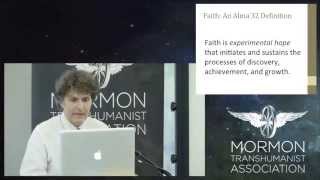
Don Bradley
An Experiment Upon the Word
Don Bradley analyzes Alma 32 as a post-biblical, post-Enlightenment reformulation of faith that draws on Jesus’s parables while transforming their meaning through scientific language. He argues that whereas the New Testament presents “taking no thought” favorably as trust in God’s providence, the Book of Mormon redeploys this phrase negatively—faith requires actively “arousing faculties” and conducting “experiments” rather than passive belief. Bradley identifies distinctly scientific vocabulary throughout Alma’s discourse (experiment, dormant, particle, discernible) and proposes a working definition: “faith is experimental hope that initiates and sustains the processes of discovery, achievement, and growth.” He suggests Latter-day Saints should learn to engage scripture through midrash—the Jewish tradition of creatively rewriting narratives to apply them to contemporary life.
You Are the New Day
The MTA Barbershop Chorus performs John Rutter’s “You Are the New Day,” a hymn of hope and renewal. Introduced by a reflection on humanity’s responsibility to shape the future through “good minds and loving hearts,” the performance celebrates themes of love, life, and the dawning possibility of each new day—affirming that hope persists even when time seems to be running out.
Jared Anderson
(De)Construction down the Rabbit Hole
Jared Anderson explores three approaches to faith crisis: apologetics, which defends inherited beliefs but leaves adherents vulnerable to new information; selective emphasis, which rebuilds meaning by highlighting a tradition’s most beneficial elements; and complete reconstruction through new myths and systems of meaning. Anderson argues that critical inquiry can only demolish worldviews—reconstruction is an art requiring theology, aesthetics, relationships, heritage, syncretism, and activism. He concludes that humanism and transhumanism offer frameworks for rebuilding when the “rabbit hole goes all the way down.”
Micah Redding
A Better Apocalypse: Ancient Eschatology for a Transhuman World
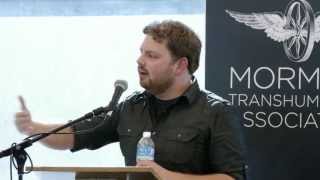
Micah Redding contrasts the failed end-of-world predictions exemplified by Harold Camping with the ancient Jewish prophetic tradition that viewed apocalypse not as history’s arbitrary termination but as moments when oppressive powers are overwhelmed by the rising tide of justice. He argues that this “better apocalypse” drew people more deeply into the world rather than out of it, inspiring figures like Martin Luther King Jr. to stand for truth even when victory seemed impossible. Redding suggests that spiritually oriented transhumanists can offer a similar forward-looking vision—one that calls humanity to courage and engagement rather than despair.