Videos

Showing 1–9 of 9
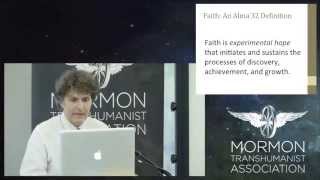
An Experiment Upon the Word
20:13

Don Bradley

An Experiment Upon the Word

Don Bradley analyzes Alma 32 as a post-biblical, post-Enlightenment reformulation of faith that draws on Jesus's parables while transforming their meaning through scientific language. He argues that whereas the New Testament presents "taking no thought" favorably as trust in God's providence, the Book of Mormon redeploys this phrase negatively—faith requires actively "arousing faculties" and conducting "experiments" rather than passive belief. Bradley identifies distinctly scientific vocabulary throughout Alma's discourse (experiment, dormant, particle, discernible) and proposes a working definition: "faith is experimental hope that initiates and sustains the processes of discovery, achievement, and growth." He suggests Latter-day Saints should learn to engage scripture through midrash—the Jewish tradition of creatively rewriting narratives to apply them to contemporary life.

Christian Transhumanism
24:40

James McLean Ledford

Christian Transhumanism

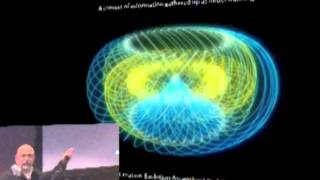
James McLean Ledford presents his vision of Christian transhumanism, arguing that salvation requires both faith and works—a combination he illustrates through an information-time diagram depicting creation, cognitive evolution, and eventual theosis. Drawing on digital physics, the Nicene Creed, and the simulation argument, he proposes that reality may be fundamentally informational and that humanity could be living in a simulation created by an advanced civilization. Ledford sees this possibility not as undermining faith but as supporting it, suggesting that creators watching their simulations could perform what appear to be miracles—and that our own technological trajectory toward brain coprocessing and quantum computing may be part of a grand cosmic gathering back to a singular, Christ-like state of being.
The New God Argument
1:02:28

Lincoln Cannon

The New God Argument

Lincoln Cannon and Joey West present the New God Argument, a logical case for faith in God that diverges from traditional Christian apologetics to justify the distinctly Mormon conception of deity. Beginning with the “faith position”—that humanity probably will not go extinct before becoming an advanced civilization—they build through the “angel argument” (that advanced civilizations are probably common if basic life is common) and the “creation argument” (that if we would create many simulated worlds, then we ourselves probably live in a created world). Three “charity arguments” then establish that our probable creators are likely more benevolent than us, since civilizations that increase in destructive capacity without corresponding increases in benevolence tend to destroy themselves. The conclusion: if basic life forms are probable and advanced civilizations create worlds, we should trust that a benevolent advanced civilization—what Mormons call God—probably created our world.