Videos

Showing 231–240 of 276
Epiphany Endangered: the Relevance of God in a Transhuman Society
18:20

Dorothy Deasy

Epiphany Endangered: the Relevance of God in a Transhuman Society

Dorothy Deasy argues that spirituality—the ongoing incorporation of transcendent insights into daily life—remains essential in a transhumanist age. While neuroscience reveals the biological processes underlying mystical experiences, understanding the machinery does not negate what those experiences mean. She positions spiritual transhumanism as a “third way” between fundamentalist rejection of science and atheistic creation without God. Deasy raises pressing bioethical concerns: humanized animals with human neurons, artificial intelligence that must reflect diverse moral perspectives, and the danger of enhancements creating a biological caste system. Whether transhumanism becomes a movement of the elite or a transfiguration that uplifts all humanity depends on whether it embraces the golden rule—the concept of interconnectedness at the heart of all faiths. “God is relevant,” she concludes, “because God remains as God always was: the whole, the entirety, the unity of creation.”

Integrationalism: Spiritual Disincentives for Humanity
16:46

James Felton Keith

Integrationalism: Spiritual Disincentives for Humanity

James Felton Keith presents his philosophy of “integrationalism,” arguing that traditional spirituality—by emphasizing individual spirits and their unique relationship with the divine—inadvertently incentivizes elitism, protectionism, and violent conflict over scarce resources. He proposes that insights from string theory, which suggest all existence is fundamentally interconnected, could provide a new framework for human cooperation. Keith contends that rather than pursuing “moral good” based on relative spiritual beliefs, humanity should focus on protecting mortal lives as inherently valuable, recognizing that our group interdependence is essential for technological and philosophical progress.

The Compatibility of Religion and Transhumanism
36:45

James Hughes

The Compatibility of Religion and Transhumanism

James Hughes argues that transhumanism—particularly its embrace of enhancement technologies—is broadly compatible with world religions when these traditions are open to setting aside literalist interpretations. Drawing on his background in Buddhism and Unitarianism, he examines metaphysics, theodicy, soteriology, and eschatology across traditions, contending that concepts like theosis in Mormonism and evolutionary progression in Hinduism and Buddhism resonate with transhumanist aspirations. Hughes distinguishes between “transhumanism” as a thin commitment to human transformation and “Transhumanism” as a specific Enlightenment ideology, suggesting that religious communities can integrate the former while maintaining their spiritual identities.

Christian Transhumanism
24:40

James McLean Ledford

Christian Transhumanism

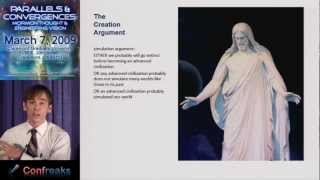
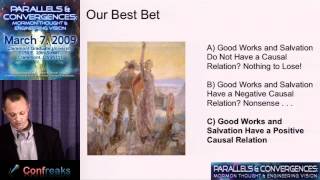
James McLean Ledford presents his vision of Christian transhumanism, arguing that salvation requires both faith and works—a combination he illustrates through an information-time diagram depicting creation, cognitive evolution, and eventual theosis. Drawing on digital physics, the Nicene Creed, and the simulation argument, he proposes that reality may be fundamentally informational and that humanity could be living in a simulation created by an advanced civilization. Ledford sees this possibility not as undermining faith but as supporting it, suggesting that creators watching their simulations could perform what appear to be miracles—and that our own technological trajectory toward brain coprocessing and quantum computing may be part of a grand cosmic gathering back to a singular, Christ-like state of being.

Theological Implications of the New God Argument
20:33

Joseph West

Theological Implications of the New God Argument

Joseph West presents the New God Argument, co-authored with Lincoln Cannon, which uses secular premises to reach conclusions compatible with Mormon theology about God. The argument builds on Nick Bostrom’s simulation hypothesis and the “great filter” concept to conclude that if humanity survives and creates many worlds, our own world was almost certainly created by an advanced civilization. West argues this creator must be benevolent—otherwise they would have destroyed themselves before achieving such capabilities. He connects this to Joseph Smith’s King Follett Discourse teaching that God was once human, and even quotes Richard Dawkins acknowledging that “godlike extraterrestrials” who “didn’t start that way” are probable.

The New God Argument
1:02:28

Lincoln Cannon

The New God Argument

Lincoln Cannon and Joey West present the New God Argument, a logical case for faith in God that diverges from traditional Christian apologetics to justify the distinctly Mormon conception of deity. Beginning with the “faith position”—that humanity probably will not go extinct before becoming an advanced civilization—they build through the “angel argument” (that advanced civilizations are probably common if basic life is common) and the “creation argument” (that if we would create many simulated worlds, then we ourselves probably live in a created world). Three “charity arguments” then establish that our probable creators are likely more benevolent than us, since civilizations that increase in destructive capacity without corresponding increases in benevolence tend to destroy themselves. The conclusion: if basic life forms are probable and advanced civilizations create worlds, we should trust that a benevolent advanced civilization—what Mormons call God—probably created our world.