Videos

Showing 271–276 of 276
Taxation in a Millennial World
20:22

Marcus Flinders

Taxation in a Millennial World

Marcus Flinders, an attorney specializing in taxation and general counsel for the Mormon Transhumanist Association, examines how taxation reveals the character of a society. He distinguishes between negative scriptural examples—where kings taxed people for personal gain—and positive tithing, where contributions flow to the community’s benefit. Flinders argues that studying tax codes illuminates our societal values: estate taxes reflect beliefs about wealth distribution, and charitable exemptions incentivize benevolence. Looking toward a “millennial world,” he envisions currency eventually giving way to exchanges of love, charity, and companionship. The highest form of “joyous taxation,” he suggests, is Christ-like atonement—willingly bearing another’s burdens so they might flourish.

Toward a Science of Spirituality
16:24

Michael Ferguson

Toward a Science of Spirituality

Michael Ferguson surveys emerging neuroscience technologies that enable researchers to decode thoughts, emotions, and visual experiences directly from brain activity patterns. He describes work at Carnegie Mellon on word recognition, Tor Wager’s emotional decoding research, and Jack Gallant’s visual reconstruction experiments at UC Berkeley. Ferguson proposes that these technologies could eventually be applied to understanding spiritual, religious, and mystical experiences—not to confirm or deny theology, but to enrich our understanding of human nature. He suggests this represents a potential bridge between humanities and physical sciences, where scientific investigation of spiritual experiences could help mediate fundamentalisms while reinvigorating societal discourse on transcendence and wisdom.

Christian Atheist Universal Immortalism
13:39

Mike Perry

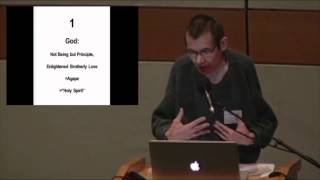
Christian Atheist Universal Immortalism

Mike Perry presents “Christian Atheist Universal Immortalism,” a philosophy combining the ethical framework of Christianity—enlightened brotherly love—with the belief that death can be overcome through scientific means rather than supernatural intervention. Perry argues that while Christian atheism provides a satisfying moral framework, it remains “deathist” in its acceptance of mortality; universal immortalism adds the commitment that all sentient beings should eventually gain salvation and eternal life through technological means such as cryonics. He views Jesus as a pioneer transhumanist immortalist whose command to “heal the sick and raise the dead” should be taken literally as our technology advances, and proposes that resurrection may be achieved through his “minibodies” theory rather than quantum archaeology, acknowledging that information may be irretrievably lost but that multiple authentic timelines could still be realized.

“How Amazing is Grace? The Role of Jesus Christ in Mormonism
16:04

Varden Hadfield

“How Amazing is Grace? The Role of Jesus Christ in Mormonism

Varden Hadfield examines the central role of Jesus Christ in Latter-day Saint theology, emphasizing that Christ is not merely a metaphor for ideal behavior but a tangible, divine being who enables resurrection and salvation through grace. Drawing on scriptural references from the Book of Mormon and New Testament, he contrasts transhumanist approaches—which emphasize human-created technologies for achieving immortality—with the Mormon view that Christ’s atonement and judgment are the essential mechanisms for eternal life. Hadfield argues that grace is not a crutch for inaction but an enabling power that motivates believers to act, suggesting that any synthesis of transhumanism and Mormonism must incorporate Christ as the author of eternal peace.