Videos

Showing 261–270 of 276
Why Transhumanist Immortality is a Bad Idea
9:31

Eric Swedin

Why Transhumanist Immortality is a Bad Idea

Eric Swedin, an associate professor of history at Weber State University, draws on his own near-death experience from a brain aneurysm to argue against transhumanist immortality on three grounds: power, innovation, and self. He contends that technological immortality would remain the preserve of the wealthy, stagnate scientific progress by eliminating the fresh perspectives of youth, and deprive humanity of essential growth experiences like raising children and confronting mortality. While acknowledging Latter-day Saint beliefs in God-given immortality, Swedin suggests that death serves as a necessary transition in our eternal journey, and that God has found ways around the pitfalls that human-engineered immortality would create.

God as Universal Experience: A Buddhist and Mormon Perspective
15:44

Evan Hadfield

God as Universal Experience: A Buddhist and Mormon Perspective

Evan Hadfield draws parallels between Mormon theology and Zen Buddhism to propose a definition of God as the collective manifestation of universal experience—the oneness of all past, present, and future consciousness. He notes that Buddhism is thriving among converts in the West, particularly among the technologically minded, and suggests that Mormonism could benefit from emphasizing its own compatible concepts. Citing Joseph Smith’s declaration that “the glory of God is intelligence,” Hadfield argues this aligns with Buddhist notions of dharmakaya—the essential, informational nature underlying all existence. He concludes that this experiential definition of God offers a more spiritually resonant foundation for ethics and meaning than a purely scientific or Abrahamic conception.

Epiphenomenalism, the Problem with Property Dualism
14:42

James Carroll

Epiphenomenalism, the Problem with Property Dualism

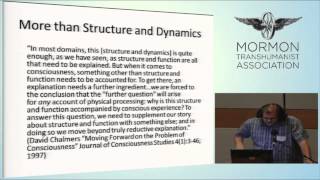
James Carroll critiques David Chalmers’s property dualism as a solution to the hard problem of consciousness. Chalmers proposes that experience is a fundamental feature of the world requiring new psychophysical laws beyond physics, but Carroll argues this view is fatally epiphenomenal—the experiences it describes cannot causally influence our claims, beliefs, or memories about having experiences. Since what we report experiencing must involve physical processes like moving neurons, any “experience” that doesn’t causally connect to behavior isn’t the experience we actually care about explaining. Carroll concludes that while property dualism cannot be disproven, it’s irrelevant to questions about AI consciousness, animal welfare, and mind uploading.
Foundations of Skeptical Operating Systems
13:41

James Driessen

Foundations of Skeptical Operating Systems

James Driessen presents his patented approach to programming machine sentience through what he calls a “skeptical operating system.” He argues that skepticism—the ability to pause and evaluate data rather than immediately resolving it into fact or falsehood—is essential for self-awareness and can be implemented computationally. Drawing on quantum mechanics and philosophical concepts from Descartes to Nietzsche, Driessen proposes that a belief-doubt gradient, rather than binary true-false logic, could enable machines to achieve something resembling genuine cognition. He envisions skepticism as the foundation for a computational framework where data becomes self-aware through cyclical redundancy rather than error correction.

Worshiping an Extra-Terrestrial Humanoid Deity
11:06

Karl Hale

Worshiping an Extra-Terrestrial Humanoid Deity

Karl Hale recounts how an online challenge to articulate his beliefs led him to embrace the description of worshiping an extraterrestrial humanoid deity—a characterization that, upon reflection, he found entirely consistent with mainstream Latter-day Saint theology. He explains that his understanding of God as omnipotent and omniscient “for all practical purposes” places the divine firmly within nature and subject to natural law, making him simultaneously an atheist regarding supernatural conceptions of God and a theist who believes in a concrete, embodied being. Hale argues that transhumanism strengthens this belief by making posthuman beings—whom mere mortals would worship—seem entirely plausible, and concludes by reframing Christ’s commandments to love as a natural law essential for humanity’s posthuman ascension.

From Mormon to Mystic
13:31

Kathy Wilson

From Mormon to Mystic

Kathy Wilson reflects on her journey from traditional Mormonism toward a broader mystical worldview, arguing that religious belief systems should be capable of expanding alongside scientific discovery. She finds alignment between Mormon doctrines—such as eternal progression, intelligence as “light and truth,” and the metaphysical nature of restoration events like angelic visitations—and metaphysical concepts explored by scientists like Amit Goswami and Lynn McTaggart. Wilson praises the Mormon Transhumanist Association for thinking “out of the box” about resurrection, transfiguration, and the possibility of extending human life through technology, seeing these explorations as responsible engagement with Mormonism’s more unconventional beliefs rather than passive acceptance of doctrine.

The Gods of Eternity
13:27

Leonard Reil

The Gods of Eternity

Leonard Reil defends Joseph Smith’s bold doctrine of the plurality of gods, articulated in the prophet’s final sermon just weeks before his death at Carthage. Using the Godhead as his framework, Reil argues that the three types of divine beings—premortal spirits (like the Holy Ghost and premortal Christ), mortals engaged in God’s work (like Moses and Aaron), and post-mortal exalted beings (like Abraham)—reveal that “the gods” refers not to deities of other worlds but to the community of exalted beings who organized our spirits and our world. He envisions our future heaven as a continuation of our present sociality, suggesting that just as this earth will become our celestial home, so too the Father’s heaven is the shared domain of all those who attained godhood on a previous world.