Videos

Showing 241–250 of 276
The End(s) of Mythology
28:51

Malcolm Dean

The End(s) of Mythology

Malcolm Dean, a research affiliate of UCLA’s Human Complex Systems Program, presents a cognitive thermodynamics framework for understanding mythology, religion, and culture as physical systems rather than mere stories. He argues that ancient myths and religious systems encode sophisticated understanding of complexity, scale invariance, and information theory in intuitive language—knowledge only recently rediscovered through modern science. Dean proposes that cultures, religions, and cognitive units form Boromean ring systems, where all three must exist together to maintain bonds; when one ring mistakes itself for another or claims fixed dominance, the result is pathology and violence. He concludes that humanity’s current planetary crisis is not an exception but the natural path of physical processes.
Positive Parametricism
17:15

Ralph Spencer Steenblik

Positive Parametricism

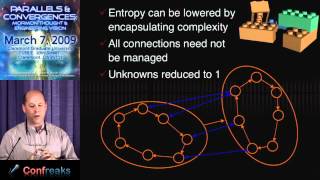
Ralph Spencer Steenblik proposes “positive parametricism” as a framework for transcending individual human limitations through collective action. He argues that the 21st century must move beyond assembly-line thinking toward an ecosystem mentality where waste becomes a resource for other systems. Drawing on swarm theory and positive psychology, Steenblik reframes transhumanism not as a merger of humans and machines but as the emergence of a human “superorganism” capable of self-organization around shared values. He identifies the key obstacle as postmodernism’s deconstruction of value hierarchies, arguing that effective decentralized organization requires mission-critical groups united by common value systems—making the Mormon Transhumanist Association’s shared commitments a potential model for this new form of collective action.

Three Spiritual Exemplars for Religious Transhumanists
15:21

Three Spiritual Exemplars for Religious Transhumanists

Roger Hansen examines the lives and ideas of three early twentieth-century thinkers—John A. Widtsoe, Alfred North Whitehead, and Pierre Teilhard de Chardin—whose work offers valuable insights for religious transhumanists. Drawing on their shared beliefs in evolutionary progress, the interconnectedness of life, and the compatibility of science and religion, Hansen argues that these “spiritual exemplars” provide a theological foundation for eternal progression and the ongoing technological revolution. He suggests that Widtsoe’s commitment to reconciling LDS theology with science, Whitehead’s process philosophy, and Teilhard’s vision of humanity evolving toward an “Omega Point” all resonate deeply with Mormon transhumanist aspirations.

Panel Discussion with All Presenters
1:02:14

Panel Discussion with All Presenters

This panel discussion from the 2012 MTA conference brings together presenters to explore the relationship between Mormonism, science, and engineering. Panelists discuss whether scientific and religious methodologies of truth are compatible, with several arguing that the two are complementary rather than contradictory—engineering provides forward-looking creation while science offers reverse-engineering of nature. The conversation delves into questions about absolute versus pragmatic truth, the role of technology in increasing human benevolence, and whether Mormon theology can accommodate both modernist optimism and postmodern awareness. Participants also address how technology, while not sufficient alone for salvation, plays an essential communal role in bringing about immortality and eternal life across dispensations.