Videos

Showing 51–60 of 276
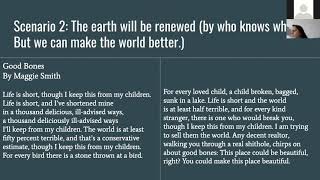
The Earth Will Be Renewed: Challenges and Opportunities with the Passive Voice
15:07

Ben Blair

The Earth Will Be Renewed: Challenges and Opportunities with the Passive Voice

This presentation examines the passive voice in the Tenth Article of Faith—“the earth will be renewed”—exploring who the agent of that renewal might be. The speaker outlines three scenarios: God alone will renew the earth, the agent is unknown but we should improve the world anyway, or humanity and our descendants are called to be the renewers. Drawing on Carl Youngblood’s work on prophetic voice and Joseph Smith’s egalitarian vision of revelation, the presentation argues that the passive voice neither names nor excludes any possible agent—leaving room for us to take responsibility. The speaker concludes with self-authored “scriptures” challenging listeners to embrace their prophetic calling, warning that the earth’s renewal is possible but not inevitable.

Paradise-Engineering, Reprogramming the Biosphere
33:33

David Pearce

Paradise-Engineering, Reprogramming the Biosphere

David Pearce presents his vision for “paradise engineering”—using biotechnology to eliminate involuntary suffering throughout the living world. Beginning with Isaiah’s peaceable kingdom where “the wolf shall dwell with the lamb,” Pearce argues that such visions are no longer ecologically illiterate fantasies but technically achievable goals. He discusses CRISPR gene editing, synthetic gene drives, and the programmability of hedonic set points, suggesting that we could choose the pain sensitivity and baseline well-being of future generations. Pearce also advocates for cultured meat as a way to end factory farming—a transition he calls both morally imperative and practically beneficial given the zoonotic origins of pandemics.

Nature and Consciousness
21:52

Jeremy Hadfield

Nature and Consciousness

Jeremy Hadfield, a philosophy, neuroscience, and computer science student at Dartmouth and intern at the Qualia Research Institute, presents the symmetry theory of valence—a framework for quantifying happiness and suffering. He proposes that mental states feel good or bad based on the symmetry of brain processes: consonant, symmetrical neural oscillations correlate with positive experiences, while dissonant patterns correlate with suffering. Using connectome-specific harmonic waves—mathematical tools borrowed from acoustics and applied to brain imaging—researchers can measure these patterns and potentially test the theory. Hadfield explores applications including understanding why meditation increases well-being, why exposure to nature improves mood, and how this framework might eventually allow us to communicate what “good” and “bad” mean to artificial intelligence in precise, measurable terms.

Deep Ecology v. Transhumanism
47:35

Jordan Harmon

Deep Ecology v. Transhumanism

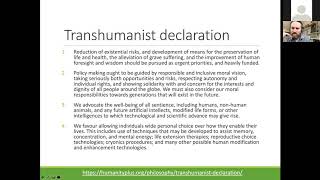
This presentation reframes the relationship between deep ecology and transhumanism as a dialectical pairing rather than an adversarial opposition, drawing on the speaker’s professional background in psychotherapy where acceptance and change strategies work together. While deep ecologists tend to view technology worship as a root problem and emphasize the inherent worth of all living systems, transhumanists place faith in science and technology to solve problems of human and nonhuman flourishing. The speaker proposes that both movements share concern for well-being beyond anthropocentrism, and suggests that transhumanists might benefit from contemplative acceptance practices—not as resignation, but as a foundation from which more sustainable change can emerge.

Mormon Views on Climate Change
19:26

Leika Patch

Mormon Views on Climate Change

Leika Patch, a BYU environmental science student, examines the disconnect between Latter-day Saint theology—which strongly supports environmental stewardship—and the climate skepticism prevalent among church members. She presents her work with the Mormon Environmental Stewardship Alliance (MESA), showing social media posts that pair quotes from church leaders like President Oaks and President Nelson with scientific data on climate change. Patch identifies three factors driving resistance: political conservatism, church culture that avoids environmental topics, and distrust of science. Despite encountering hostile responses online, she highlights encouraging comments and reports that church leaders at various levels are increasingly engaged with sustainability issues.