Resources

  • Articles
  • Authors
  • Quotations
  • Search
  • Tags
  • Topical Guide
  • Videos

Videos

Showing 1–10 of 11
Previous1
Open Thou Mine Eyes
22:34

Chris Bradford

Open Thou Mine Eyes

2018.04.20

Chris Bradford explores the tension between technological instrumentalism and genuine human relationship, drawing on Martin Buber's distinction between "I-It" and "I-Thou" encounters. He argues that a purely technological approach to the world risks reducing people and nature to mere objects, and that Mormon transhumanism must complement its technological aspirations with the cultivation of empathy, charity, and recognition of the divine in others. Bradford contends that the grace saturating the world—visible when our "eyes are opened"—calls disciples of Christ to see and serve God in every neighbor, making the transhumanist project a fundamentally religious endeavor.

Seek Ye First the Kingdom of God
19:52

Ben Blair

Seek Ye First the Kingdom of God

2016.04.20

Ben Blair argues that strong communities are byproducts of pursuing worthy aims rather than ends in themselves. He critiques both religious institutions that equate themselves with the kingdom of God and secular groups that make community their primary goal, suggesting that both miss the driving force of shared purpose. Drawing on examples from the D-Day invasion to the Mormon pioneers, Blair proposes that the Mormon Transhumanist Association’s aspirational vision—working collaboratively toward becoming gods who lift each other up—provides the kind of "work cut out for us" that sustains robust, long-lasting communities.

Transhumanism as Grace
20:38

Chris Bradford

Transhumanism as Grace

2016.04.20

Chris Bradford responds to Richard Bushman’s question about grace in transhumanism by proposing that divine grace is best understood as “givenness”—everything God has given us, in whom we “live, move, and have our being.” Drawing on Russian cosmist Nikolai Fedorov and Mormon scripture, he argues that God needs humanity to complete the divine work begun in creation. Bradford contends that all matter is infused with divinity, blurring the line between divine and human action, and that the transhumanist project—if infused with the spirit of Christ—can build a temple rather than another Tower of Babel.

The Transhumans of Pre-history According to the Urantia Revelation
38:50

Byron Belitsos

The Transhumans of Pre-history According to the Urantia Revelation

2014.05.29

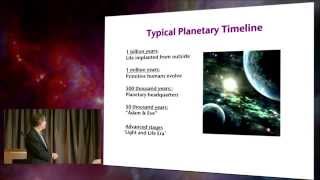
Byron Belitsos introduces the Urantia Revelation—a purportedly celestial text published in 1955—and explores its implications for transhumanist thought. He argues that the Urantia Book describes prehistoric genetic interventions by celestial beings, including a mission by Adam and Eve as biological "uplifters," and contends that such transhumanist projects require spiritual depth and celestial oversight to succeed. Belitsos connects these ancient narratives to contemporary scientific findings, including genetic research suggesting a single-source introduction of brain-enhancing genes roughly 37,000 years ago, and calls for an "integrally informed" transhumanism grounded in spirituality rather than materialism.

The Kingdom of God and the Transhuman Age
18:35

Dorothy Deasy

The Kingdom of God and the Transhuman Age

2014.04.29

Dorothy Deasy argues that the perceived threats of transhumanism—often compared to Nazi eugenics—stem not from technology itself but from ideologies of total domination and the commercialization of humanity. Drawing on Hannah Arendt’s analysis of totalitarianism, she contends that spiritual transhumanism, grounded in nonviolence, human rights, and co-creation with God, can bring about the promises of the kingdom. Deasy calls for ecosystem and symbiotic thinking across all institutions, urging that transfiguration of society must be intentional and communal rather than individualistic.

Analysis, Loss of Meaning, and Religious Transhumanism
12:09

Micah Redding

Analysis, Loss of Meaning, and Religious Transhumanism

2014.04.29

Micah Redding explores how analytical thinking, while essential for progress, can dismantle the systems of meaning that give our lives coherence—much like dissecting a frog leaves something missing even when all the pieces remain. He argues that religious transhumanists often excel at analysis but struggle with the complementary task of building new meaning, leading to a sense of loss even among those who successfully reconstruct their worldviews. Redding proposes that the solution lies not in abandoning rationality but in becoming better storytellers, recognizing that religious transhumanism offers a uniquely powerful narrative—one that unites ancient questions with modern ambitions into a single story about what it means to be human.

Amit Goswami on Quantum Physics, Consciousness and Health
1:22:06

Amit Goswami

Amit Goswami on Quantum Physics, Consciousness and Health

2013.11.27

Amit Goswami argues that quantum physics reveals a reality beyond space-time—a domain of potentiality from which consciousness chooses what becomes actual. He presents experimental evidence for nonlocal communication between correlated minds, showing that intention and meditation can produce measurable brain activity in distant subjects. Goswami applies these principles to health and healing, proposing that blocked emotions—particularly suppressed love associated with the heart chakra—can impair immune function and contribute to diseases like breast cancer. He advocates for a science that treats humans not as machines but as conscious beings capable of participating in their own healing through quantum leaps of insight and transformation.

Integrationalism: Spiritual Disincentives for Humanity
16:46

James Felton Keith

Integrationalism: Spiritual Disincentives for Humanity

2012.05.22

James Felton Keith presents his philosophy of "integrationalism," arguing that traditional spirituality—by emphasizing individual spirits and their unique relationship with the divine—inadvertently incentivizes elitism, protectionism, and violent conflict over scarce resources. He proposes that insights from string theory, which suggest all existence is fundamentally interconnected, could provide a new framework for human cooperation. Keith contends that rather than pursuing "moral good" based on relative spiritual beliefs, humanity should focus on protecting mortal lives as inherently valuable, recognizing that our group interdependence is essential for technological and philosophical progress.
Wise as Serpents, Harmless as Doves: Subverting Dogma in an LDS Context
12:16

Chris Bradford

Wise as Serpents, Harmless as Doves: Subverting Dogma in an LDS Context

2012.04.20

Chris Bradford offers practical strategies for introducing transhumanist ideas within LDS congregations while maintaining community bonds. Drawing on Jesus’s instruction to be "wise as serpents and harmless as doves," he emphasizes the importance of reassuring fellow members that one’s intent is to fulfill rather than destroy their faith. Bradford recommends grounding discussions in scripture, expressing unconventional perspectives in non-threatening ways, building bridges through shared language, and avoiding ego-driven arguments—all while communicating with an aesthetic that the community associates with the Holy Spirit.

From Mormon to Mystic
13:31

Kathy Wilson

From Mormon to Mystic

2012.04.20

Kathy Wilson reflects on her journey from traditional Mormonism toward a broader mystical worldview, arguing that religious belief systems should be capable of expanding alongside scientific discovery. She finds alignment between Mormon doctrines—such as eternal progression, intelligence as "light and truth," and the metaphysical nature of restoration events like angelic visitations—and metaphysical concepts explored by scientists like Amit Goswami and Lynn McTaggart. Wilson praises the Mormon Transhumanist Association for thinking "out of the box" about resurrection, transfiguration, and the possibility of extending human life through technology, seeing these explorations as responsible engagement with Mormonism's more unconventional beliefs rather than passive acceptance of doctrine.

Previous1