Videos

Showing 21–30 of 276
Brief Remarks from Several MTA Officers
12:48

Spencer Cannon

Brief Remarks from Several MTA Officers

Several MTA officers share brief personal reflections on their experiences with the Mormon Transhumanist Association. Connie Packer describes finding encouragement to develop and share her thoughts in a community of respectful intellectual debate. Second-generation members Dallin Bradford and Spencer Cannon reflect on growing up with transhumanist ideals, describing how the MTA provides a nuanced lens for integrating faith and science. Joseph West speaks of how the association enabled him to live authentically within Mormon principles, transforming his religion into a resource rather than a source of conflict. The speakers emphasize themes of creation, compassion, and courage as essential qualities for building a better future.

Make Yourself Human Again
19:54

Wolf Tivy

Make Yourself Human Again

The speaker examines four major ideological positions on AI—denialism, optimism, safetyism, and accelerationism—and finds each wanting. Denialism ignores mounting evidence that artificial general intelligence is achievable. Optimism fails to recognize that AGI, unlike other technologies, cannot be controlled because it can act autonomously beyond human strategic capabilities. Safetyism’s endgame—a “singleton” AI that controls the world to prevent unsafe AI—is both totalitarian and likely impossible given fundamental limits on proof systems. Accelerationism, while sophisticated in its arguments about thermodynamic gradients and evolutionary progress, asks humans to surrender their agency for abstract narratives beyond their control. The speaker’s conclusion: what we fear about AI is that it will embody the dangerous, open-ended agency we have denied ourselves. Rather than worshipping or fearing AI, we should focus on developing our own moral agency and “make ourselves human again.”

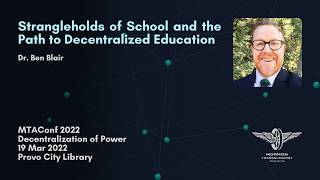
Strangleholds of School and the Path to Decentralized Education
19:19

Ben Blair

Strangleholds of School and the Path to Decentralized Education

Ben Blair, co-founder of New Lane University, argues that traditional higher education holds students in a “stranglehold” through control of cost, scheduling, geography, and student records. He proposes a decentralized model where educational pathways—built from discrete learning objectives—can be created, improved, and verified by experts worldwide without requiring institutional intermediaries. Blair describes how New Lane offers college degrees for $1,500 using open-source resources, self-assessment, and oral examinations conducted via video conference. He envisions a future where curriculum continuously improves through expert competition, instruction is optimized at the learning-objective level, and students own their own educational records.

Harbergeorgism: Sustainable Economic Development for the Web3 Era
18:30

Bernardo Vicente

Harbergeorgism: Sustainable Economic Development for the Web3 Era

Bernardo Vicente presents Harbergeorgism, an economic theory combining Henry George’s land value tax with Harberger taxation’s self-assessed asset pricing. Vicente argues that Web3 technologies—including city coins, DAOs, and blockchain-based property systems—create opportunities to implement these long-theorized economic mechanisms. The framework envisions decentralized city governance where land ownership generates community revenue through land value taxes, while Harberger taxes on businesses encourage efficient asset allocation by requiring owners to sell at their declared valuations. Vicente contends that crypto cities and metaverse environments should develop new economic models rather than replicate legacy systems.