Videos

Showing 211–220 of 276
The Evolution of God: What Evolution Says about the Existence and Nature of God
18:48

James Carroll

The Evolution of God: What Evolution Says about the Existence and Nature of God

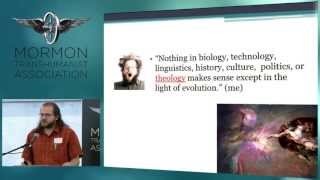
James Carroll argues that evolution—understood broadly as a search strategy producing complexity through cooperation, specialization, and trade—offers insights into the potential existence and nature of God. Tracing the pattern from RNA molecules forming symbiotic relationships with DNA, to eukaryotic cells, to multicellular organisms, to human collective intelligence, he identifies a consistent mechanism: simpler entities merging into more complex collectives. Carroll suggests this trajectory points toward future beings that are “one yet separate, separate yet one”—a description resonant with trinitarian theology. Rather than a supernatural creator outside nature, evolution predicts a God emerging within nature through the same processes that produced us.
The Free Exercise Clause and Genetic Engineering Regulation
20:09

John Niman

The Free Exercise Clause and Genetic Engineering Regulation

John Niman’s presentation, “The Free Exercise Clause and Genetic Engineering Regulation,” explores the intersection of constitutional law and emerging technologies. Niman argues that religions, particularly Mormon transhumanists, should have access to special legal protections under the Free Exercise Clause, potentially accelerating scientific discovery in fields like genetic engineering. He examines the evolution of jurisprudence surrounding the clause, focusing on the Religious Freedom Restoration Act (RFRA) and its impact on legal standards, and emphasizes the broad scope of religious exercise and the government’s burden to demonstrate compelling interest and narrow tailoring when infringing upon it.

Authentic Mormonism and Resource Mobilization
16:41

Joseph West

Authentic Mormonism and Resource Mobilization

Joseph West explores what constitutes authentic Mormonism and how a progressive religious movement might mobilize resources for collective action. Drawing on sociological theory and the work of Pierre Bourdieu, he defines authenticity in two senses: the subjective experience of resonance with one’s deepest interpretations of the faith, and the objective measure of whether a religious expression actually mobilizes people. West argues that early Mormonism’s authenticity lay not merely in its grand fundamental principles but in its radical economic and family practices—particularly its communalism, which Leonard Arrington documented as incompatible with liberal capitalism. He challenges the Mormon Transhumanist Association to tap into whatever made those practices authentic while acknowledging that the creative work of synthesis can only come from prophetic, charismatic vision rather than sociological analysis.

The Legal Rights of Sentient Machines
17:55

Marcus Flinders

The Legal Rights of Sentient Machines

Marcus Flinders, an attorney specializing in corporate law, traces the history of legal rights from Socrates through the Declaration of Independence to modern United Nations conventions, examining how “power people” have historically granted or denied personhood to others. He uses the Dred Scott decision and the evolution of animal rights as case studies to illustrate how rights arguments develop gradually and depend on who holds power. Flinders then applies this framework to the coming question of machine rights, arguing that as artificial beings develop self-awareness, free will, and the capacity to feel pain, they will increasingly demand legal recognition. Drawing on LDS theology about spirits choosing bodies and intelligence attracting intelligence, he suggests that highly advanced machine bodies might attract souls seeking honorable vessels.

An Alternative to Quantum Archaeology in Resurrecting the Dead
16:33

Mike Perry

An Alternative to Quantum Archaeology in Resurrecting the Dead

Mike Perry, a longtime cryonicist and author of Forever for All, proposes “parallel recreation” as an alternative to quantum archaeology for resurrecting the dead. While quantum archaeology attempts to retrodict the exact positions of atoms throughout history—an approach Perry finds implausible given quantum uncertainty—his method accepts some loss of historical information while still achieving meaningful resurrection through “informed guesswork.” Drawing on multiverse theory and an informational view of reality where identical copies are distributed across infinite universes, Perry argues that recreating persons consistent with surviving historical records would yield authentic versions of those who once lived. He views cryonics as the preferable path, allowing one to be a benefactor in future resurrection efforts rather than merely a beneficiary.