Videos

Showing 121–130 of 276
The Horror of (Mormon) Transhumanism
28:57

Jacob Baker

The Horror of (Mormon) Transhumanism

Jacob Baker presents a philosophical challenge to transhumanism through the lens of “cosmic pessimism,” drawing on thinkers like Eugene Thacker, Thomas Ligotti, and Ray Brassier who question whether the universe is fundamentally indifferent to human existence. He introduces Thacker’s distinction between “the world” (as experienced by humans), “the earth” (in itself), and “the planet” (explicitly indifferent and dangerous to humanity)—arguing that transhumanism’s optimism about human potential may lack sufficient grounding. Baker extends this critique to Mormonism’s inherent optimism, suggesting that if becoming a god means eternally sharing in creation’s suffering rather than transcending it, then deification itself becomes “somewhat horrific to contemplate”—not as an anti-transhumanist argument, but as a challenge meant to strengthen and refine the philosophy.

Key to the Science of Theology
17:59

Lincoln Cannon

Key to the Science of Theology

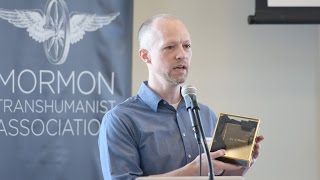
Lincoln Cannon opens the 2016 MTA conference by reading from Parley Pratt’s 1855 book, The Key to the Science of Theology, whose enthusiastic descriptions of technological progress—railroads, telegraphs, and photography—resonate remarkably with transhumanist ideals. He traces a lineage of Mormon apostles who championed science, including John Widtsoe, B. H. Roberts, and James Talmage, before announcing his transition from president after ten years and presenting a copy of Pratt’s book—once owned by Talmage—to his successor, Christopher Bradford. Cannon reflects that change is essential to progress, and as religious transhumanists, “we know better than most that change is too often resisted most when it’s needed most.”
The Infinite Resurrection
13:32

Micah Redding

The Infinite Resurrection

Micah Redding, Executive Director of the Christian Transhumanist Association, argues that Christianity is fundamentally the religion of resurrection—not merely the immortality of the soul, which was common across the ancient world, but the resurrection of the body. He outlines three profound implications of this doctrine: it affirms the goodness of physical reality against Gnostic beliefs that matter is evil; it establishes the intrinsic value of life and our daily activities rather than treating existence as merely “biding time for death”; and it unites humanity in a shared future where the consequences of our actions matter. For early Christians, resurrection was not a single event but an ongoing organic process beginning with Jesus and extending through his followers to the transformation of the entire cosmos.

Zion: Some Assembly Required
19:50

Nathaniel Givens

Zion: Some Assembly Required

Nathaniel Givens examines Zion through the lens of systems complexity theory, arguing that building a Zion society requires tools rather than blueprints—decentralized, flexible approaches rather than rigid, centralized plans. Drawing on the concept of superorganisms, he explains how unity and altruism emerge when individual agents overcome coordination problems and the “prisoner’s dilemma” of self-sacrifice for collective good. Crucially, Givens contends that humanity’s “broken” ultra-sociality is a feature, not a bug: if we were perfectly aligned like ant colonies, we would lack love, empathy, and individuality. True Zion requires “mindful altruism” and “heterogeneous unity”—giving consciously to others while tolerating diversity on non-essential issues.