Videos

Showing 101–110 of 276
Emergent Mormon Perspectives on Kurzweilian Epochs of Evolution
22:07

Caleb Jones

Emergent Mormon Perspectives on Kurzweilian Epochs of Evolution

Caleb Jones presents an emergentist interpretation of Ray Kurzweil’s six epochs of evolution through the lens of Mormon theology. He traces the progression from atomic structures through biological evolution, neural development, technological advancement, and ultimately toward post-human consciousness—drawing parallels with Mormon teachings about eternal progression and the divine potential of humanity. Jones argues that Mormonism’s naturalistic ontology and eschatology provide a robust framework for syncretizing science and religion, suggesting that traits emerging from each epoch carry forward into subsequent ones, with religion’s adaptability being crucial for flourishing in technologically transformed futures.

Caring for Creation: an LDS Perspective
23:42

George Handley

Caring for Creation: an LDS Perspective

George Handley outlines ten distinctive LDS doctrines that provide theological resources for environmental stewardship, including the belief that Earth is humanity’s intended eternal home rather than a mere way station, that bodies and sensory experience are to be treasured, and that all life forms were created spiritually before physically and are entitled to “multiply and replenish.” He emphasizes that LDS teachings on creation from unorganized matter (rather than ex nihilo) imply reverence for natural processes, while scriptures like the Word of Wisdom and the Law of Consecration mandate eating locally, consuming sparingly, and redistributing resources to the poor. Handley argues that the Anthropocene demands Latter-day Saints bring together both scientific literacy and religious values to adequately respond to environmental challenges.

The Key and Promise of Transhumanism for a Skeptic
19:17

Jacob Baker

The Key and Promise of Transhumanism for a Skeptic

Jacob Baker, a philosopher following the pessimistic tradition, offers a skeptic’s charitable exploration of what he finds compelling in Mormon transhumanism. He presents a “Trinity of Transhumanist Skepticism”: Thomas Ligotti’s cosmic pessimism, Slavoj Žižek’s questioning of autonomous subjectivity, and Mary Shelley’s warnings about unchecked ambition. Baker finds redemption in the concept of “transascendance”—that we transcend one another through relationship, making the other person a figure of the infinite. He suggests transfigurism uniquely addresses his critics: relationships themselves become the teleology, personhood emerges from messy entanglement rather than isolated autonomy, and the system is willing to climb its own ladder to its death rather than becoming an idol.

The Past, Present, and Future of Religion
23:23

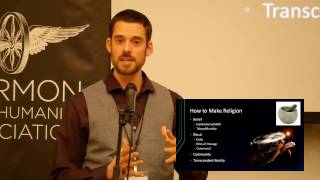
Jared Anderson

The Past, Present, and Future of Religion

Jared Anderson examines religion through the lens of human cognitive limitations, arguing that religion is a powerful cultural technology that has evolved alongside humanity. He traces religion’s origins to our evolutionary need for hyper-agency detection and explains how shared ritual transformed individual superstition into a uniquely effective mechanism for cooperation and social cohesion. Anderson presents demographic data showing that religion will remain dominant globally through 2050, with Islam as the fastest-growing faith, while noting that fundamentalist movements outperform progressive ones in providing psychological and social goods. He challenges both religious and secular audiences to recognize religion’s enduring power and calls for innovative approaches that can harness its potential while addressing its limitations—framing this as a “race to the death between innovation and cataclysm.”

Christianity as Transcendent Humanism: Humanity’s Infinite Reach
14:46

Micah Redding

Christianity as Transcendent Humanism: Humanity’s Infinite Reach

Micah Redding unpacks the early Christian doctrine of Christ’s bodily ascension as expressing a “transcendent humanism”—the belief that humanity, not angels, holds the supreme role in cosmic destiny. Drawing on Psalm 8 and the book of Hebrews, he shows how the first Christians insisted Christ retained his human body in heaven precisely because discarding it would mean humanity could not fulfill God’s purposes. This vision holds together three rare commitments: unlimited human potential, transformative progress through history, and radical equality of all persons. Physicist David Deutsch’s work on the human mind as a “universal Turing machine” with infinite reach offers striking scientific resonance with this ancient theological claim about human nature.