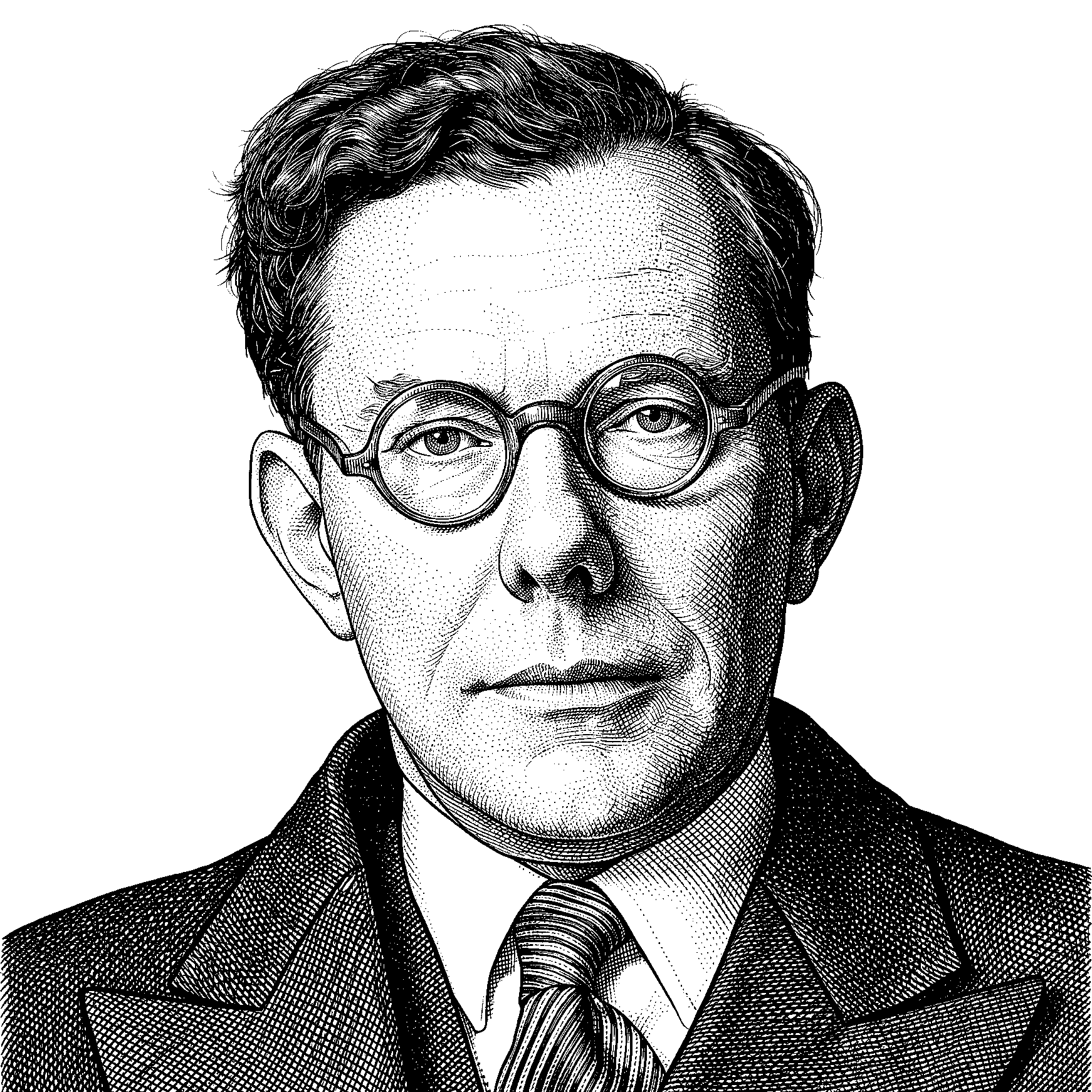
Paul Tillich (1886-1965) was a German-American theologian and philosopher whose reworking of Christian doctrine in the language of existentialism made him one of the most widely read theologians of the twentieth century. Ordained a Lutheran pastor, he served as a chaplain in the German army during the First World War, an experience that left him with a lasting sense of the fragility and anxiety built into human existence. He taught at several German universities through the 1920s and was dismissed from his post at Frankfurt in 1933 for opposing the Nazi regime, after which he emigrated to the United States. He spent the rest of his career at Union Theological Seminary, Harvard, and the University of Chicago, writing across philosophy, culture, and systematic theology.
Tillich’s central move was to redefine the terms of religious thought themselves. He described faith as ultimate concern, the orientation of a person’s whole being toward whatever matters most to them, rather than assent to a set of propositions, and he spoke of God not as a being among other beings but as the ground of being itself, the power by which anything exists at all. He treated religious symbols and myths as necessary and dangerous in equal measure: a myth taken literally becomes an idol, mistaking a finite vehicle for the infinite reality it carries. What he called a broken myth—a myth consciously held as myth rather than confused with fact—was, for him, not a diminished faith but the condition of an honest one, since only a broken myth lets worship remain worship of the unconditioned rather than worship of its own image. His three-volume Systematic Theology (1951-1963) and his widely read The Courage to Be (1952) applied this method to doubt, anxiety, and meaning, arguing that authentic faith includes rather than excludes serious doubt. That method of correlation, answering the questions posed by human existence and culture with the resources of theology, let him engage psychology, art, and politics as theological material in their own right.
Tillich’s redefinition of God as ground of being rather than a being among beings, and of faith as ultimate concern rather than assent, opened theology to the kind of expansive, less literal reading that later thinkers would extend toward technology and human transformation. Writers exploring a transhumanist reading of Christianity have drawn directly on Tillich’s framework, finding in his account of self-transcendence and his refusal to locate God at a fixed point outside the natural order room to speak of theosis, of humanity’s drive toward its own divine potential, as continuous with serious Christian thought rather than opposed to it. Tillich himself wrote before any of that technology existed, and he would likely have met transhumanist claims with the same demand for courage under doubt that he asked of every ultimate concern. But the conceptual room he opened, where God is found in the depth and ground of existence rather than in a supernatural exception to it, remains one of the more hospitable inheritances nontraditional religious thought has from twentieth-century theology.