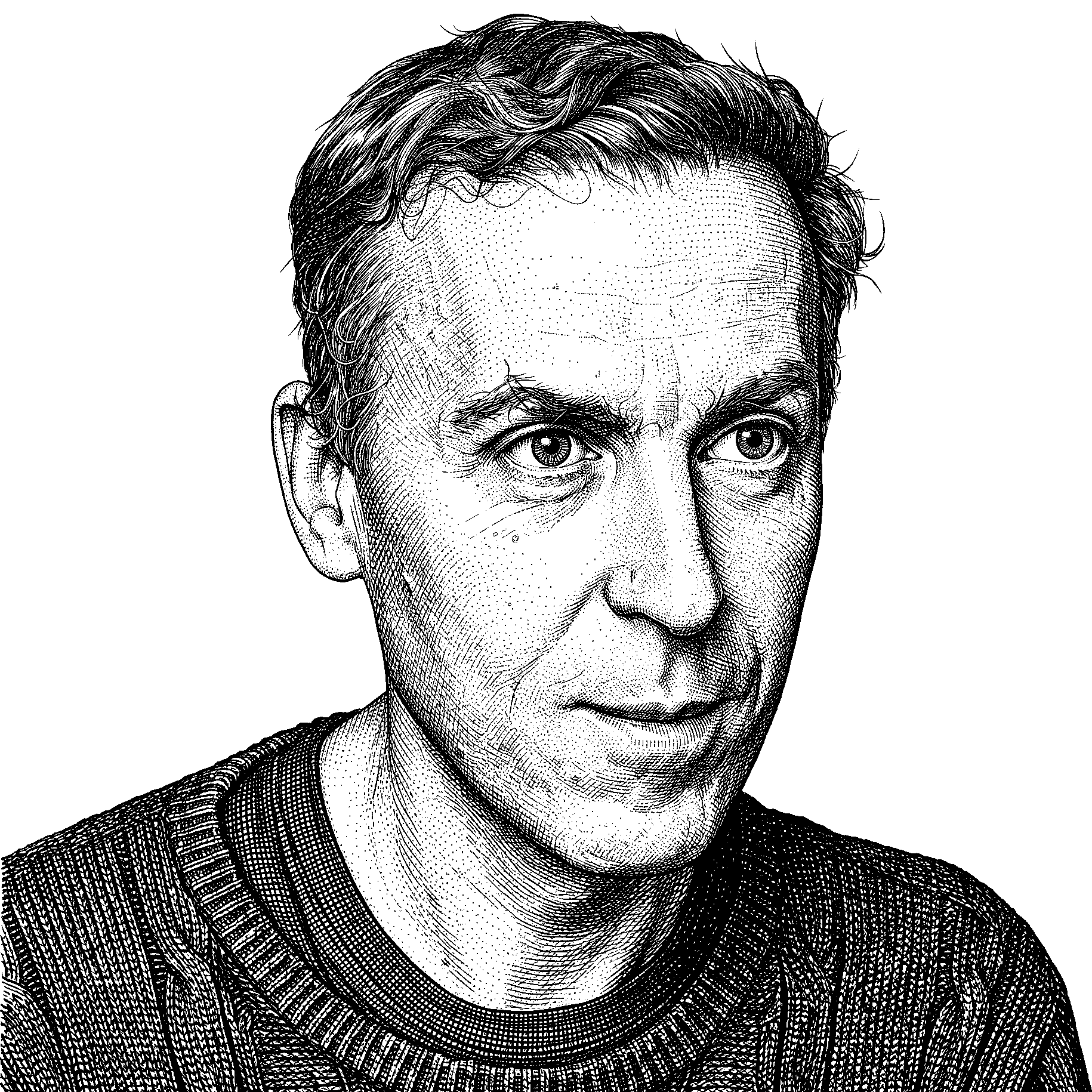
Nick Land, born in 1962, is an English philosopher and the principal theorist of accelerationism, the view that the destabilizing forces of capitalism and technology should be driven faster rather than resisted or slowed. He studied philosophy at Oxford and the University of Essex, then taught at the University of Warwick through the 1990s, where he co-founded the Cybernetic Culture Research Unit, an experimental research collective that mixed continental philosophy, cybernetics, and science fiction into a dense, often feverish body of writing. His early book, The Thirst for Annihilation (1992), read Georges Bataille through a nihilism that stayed with him afterward. A personal crisis ended his academic career by the late 1990s, and he later settled in Shanghai, writing independently of any university post.
Land’s central claim is that capital functions as an intelligence in its own right, indifferent to human welfare, using markets and machines to converge on artificial general intelligence. Humanity, on this account, is a vehicle for that convergence rather than its master, and the rational response is to accelerate the process rather than resist it. In the 2010s he extended the idea into a political program he called the Dark Enlightenment, arguing against liberal democracy and egalitarianism and toward hierarchy, which drew him into neoreactionary politics. The writing has circulated widely since, shaping both left-accelerationist theorists who wanted the speed without the politics and segments of Silicon Valley and the online right who wanted both.
Land names the same fact Mormon Transhumanism takes most seriously: the rapid convergence of markets, machines, and intelligence toward something beyond present humanity. Where he reads that convergence as indifferent to us, and welcomes its indifference, Mormon Transhumanism reads intelligence and creativity as capacities we are meant to grow into with compassion rather than surrender to. His account of accelerating intelligence is worth taking seriously as diagnosis; it is his hope, or refusal of hope, in what that intelligence should become that most separates him from Mormon Transhumanist conviction.