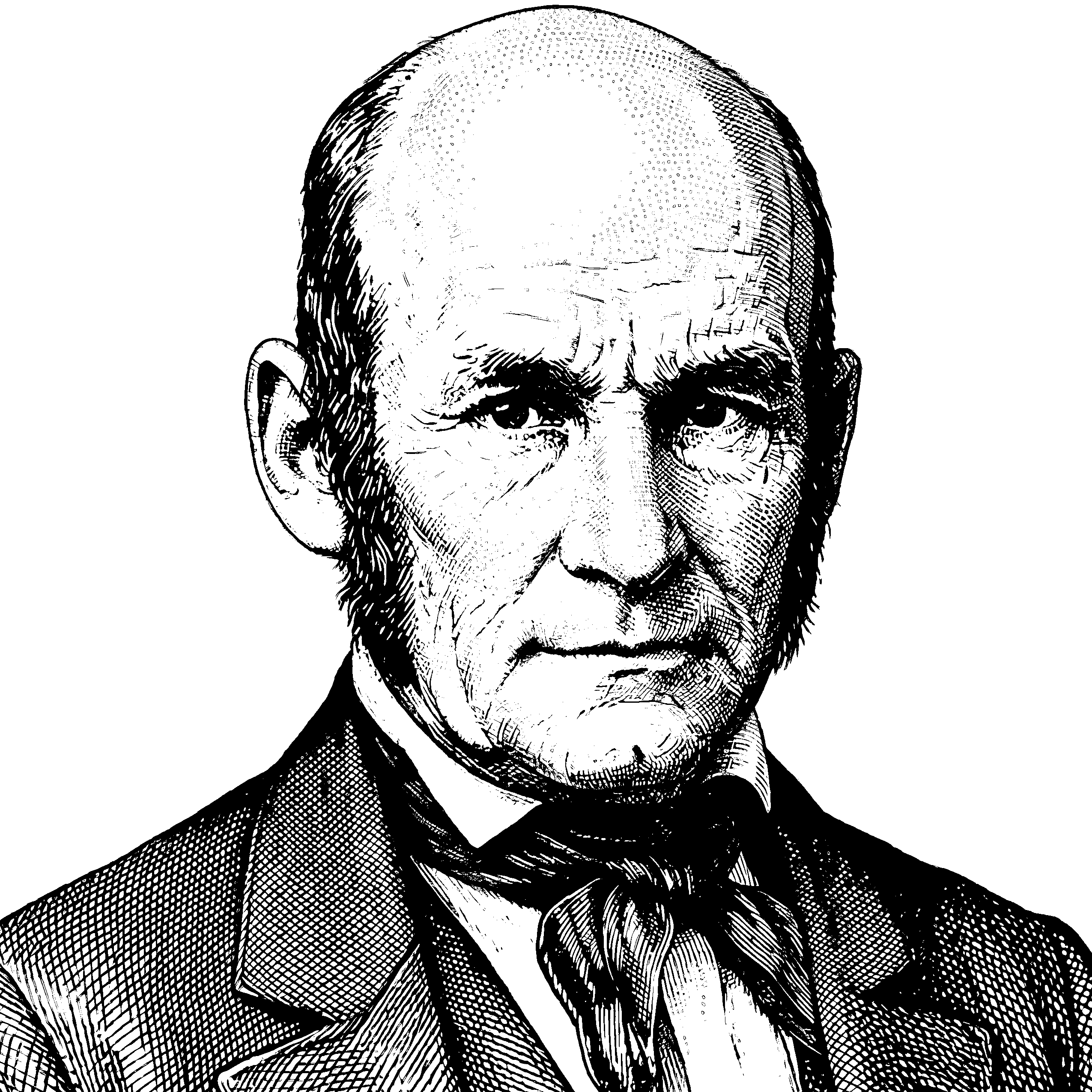
Heber Chase Kimball (1801–1868) was an American religious leader, missionary, and settler who served as one of the original members of the Quorum of the Twelve Apostles of The Church of Jesus Christ of Latter-day Saints and, from 1847 until his death, as First Counselor to President Brigham Young. Born in Sheldon, Vermont, Kimball worked as a potter before joining the Church in 1832 and quickly becoming one of its most energetic and effective early missionaries. He led the first Latter-day Saint mission to Great Britain in 1837, a journey that resulted in thousands of conversions and established a transatlantic gathering movement that would shape the demographic character of early Utah.
Kimball was a central figure in the organizational and physical building of the Latter-day Saint community across its most turbulent decades—the Missouri persecutions, the Nauvoo era, the martyrdom of Joseph Smith, and the overland exodus to the Salt Lake Valley. As Brigham Young’s closest counselor he helped govern the territory of Utah through its formative years, wielding both ecclesiastical and civic influence. His personal loyalty to Joseph Smith was absolute, and his preaching style was earthy, unpolished, and remarkably direct—qualities that made him beloved among pioneer settlers.
Kimball’s theological instincts ran deep. His sermons returned repeatedly to the radical naturalism at the heart of early Mormon theology: God is not a being apart from nature but a being within it, who acquired knowledge through experience and inheritance, just as human beings do. His image of an infinite chain of fathers—each connected to one still further back, stretching without arbitrary terminus into the cosmos—anticipates the kind of open-ended, naturalistic cosmology that Mormon transhumanism takes espouses. Where others might invoke divine mystery to close off inquiry, Kimball pressed the logic of eternal progression outward, suggesting that the universe is populated with intelligences in various stages of development, and that humanity’s own trajectory extends without ceiling toward greater knowledge, greater power, and greater kinship with God.