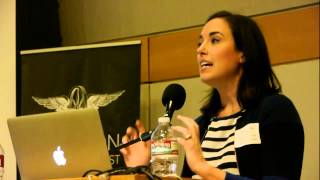
Chelsea Shields is a biocultural anthropologist, TED Fellow, and researcher whose work explores the evolutionary foundations of religious belief and the physiological power of social connection. Raised in a Latter-day Saint family in Utah, she went on to earn dual PhDs in biological and cultural anthropology from Boston University in 2017.
Shields’ academic research focuses on the concept of social susceptibility—how human bodies have evolved to be deeply responsive to social interaction and meaning-making. Over the course of a decade, she conducted extensive fieldwork with Asante indigenous healers in central Ghana, studying the evolution and elicitation of placebo and nocebo effects in ritual healing ceremonies. Her dissertation, “The Social Life of Placebos,” argues that grounding human behavior in social adaptations reveals important discoveries across placebo studies, religion, pain, stress, and empathy. She presented at the 2014 Conference of the Mormon Transhumanist Association on the evolutionary psychology of religion, examining how religious belief functions as a powerful biocultural force—shaping neural development, social bonding, and coping mechanisms—and how understanding these processes is essential for anyone thinking seriously about the future of the human brain and body.
Shields is a three-time TED speaker, an advocate for gender equality within religious communities, and founder of Brandthropologie Agency, where she applies her research in social susceptibility and nonverbal communication to brand strategy and consumer research. She lives in Salt Lake City with her family.