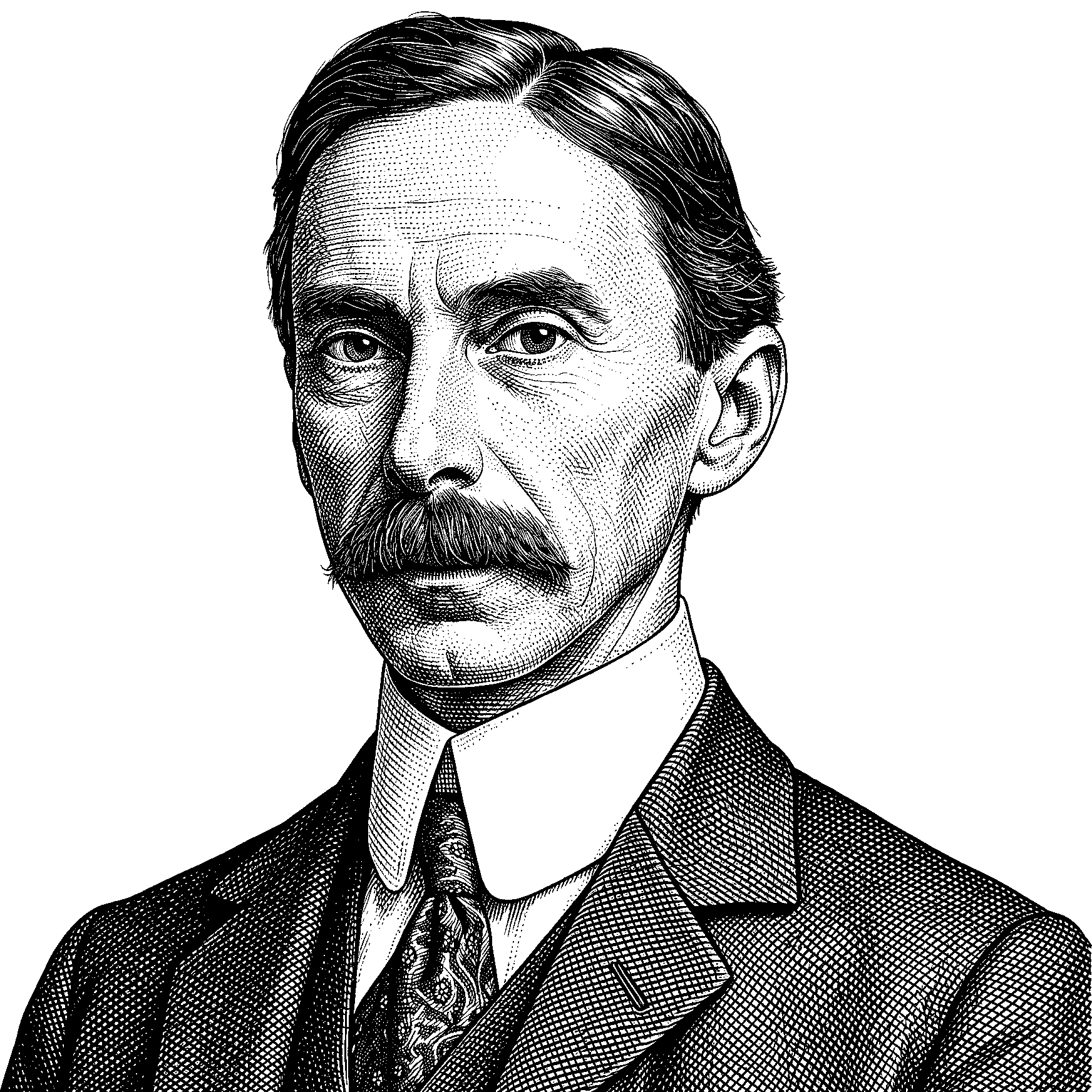
Alfred North Whitehead (1861-1947) was a British mathematician and philosopher known for his early work in mathematical logic and his later development of process philosophy. Born in Ramsgate, Kent, he studied mathematics at Trinity College, Cambridge, and remained there as a fellow and lecturer for more than two decades, teaching and publishing on algebra, geometry, and the foundations of mathematics.
His most consequential early achievement was Principia Mathematica, written with his former student Bertrand Russell and published in three volumes between 1910 and 1913. The work attempted to derive the whole of mathematics from a small set of logical axioms, and it became one of the central texts of twentieth-century logic, shaping subsequent debates in the philosophy of mathematics even where its technical program was later challenged by Gödel's incompleteness results.
In 1910 Whitehead left Cambridge for London, where he taught at University College London and then Imperial College, and where his interests broadened from mathematics into the philosophy of science and education. He wrote on the concepts of space, time, and matter in relativity theory, proposing his own alternative account of relativity distinct from Einstein's, and he served on commissions concerned with the reform of secondary and university education, arguing against rote learning in favor of teaching ideas in their living connections.
In 1924, at age sixty-three, Whitehead moved to Harvard University, where he spent the rest of his academic career and produced the metaphysical works for which he is best known, including Science and the Modern World (1925) and Process and Reality (1929). These books developed what came to be called process philosophy, which treats reality as composed of events of becoming rather than fixed substances, and which assigns value, experience, and a kind of creativity to the basic constituents of nature. Process and Reality also includes an account of God as a factor within the cosmic process rather than an unchanging sovereign outside it, an idea that later gave rise to process theology as a distinct field.
Whitehead's influence has been most durable in philosophy of science, metaphysics, and theology, particularly through process theologians who built on his account of God and creativity, and his work on education and the unity of knowledge continues to be cited in discussions of curriculum and pedagogy. He died in Cambridge, Massachusetts, in 1947.