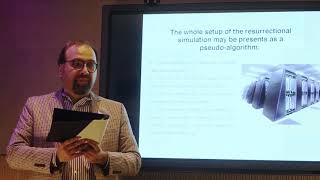
Alexei Turchin (born 1973, Moscow) is a Russian independent researcher, author, and transhumanist thinker whose work concentrates on existential risk, life extension, and the theoretical and technological pathways to human resurrection. Educated in physics and art history at Moscow State University, he has been an active figure in the Russian transhumanist movement since 2007 and a contributor to the Arch Mission Foundation, which is dedicated to preserving human knowledge across deep time.
Turchin has written extensively on what he frames as a multilevel strategy for immortality: Plan A (defeating aging), Plan B (cryonics), Plan C (digital immortality), and Plan D (multiverse or quantum immortality). His philosophical work engages questions of personal identity, the nature of the connectome, and the informational basis of human consciousness—arguing that death is, at its core, a loss of information, and that resurrection is therefore a project of information reconstruction. Drawing on the Russian cosmist tradition, especially Nikolai Fedorov’s vision of the universal resurrection of the dead, Turchin argues that a sufficiently advanced superintelligent AI could simulate all of human history in enough detail to reconstruct every person who ever lived, transferring them into personalized continuations of existence.
This vision resonates deeply with Mormon transhumanist hopes for technological resurrection and the redemption of the dead. At the 2019 Mormon Transhumanist Association Conference, themed “Redeeming Our Dead,” Turchin presented these ideas directly, proposing that benevolent superintelligences—far outnumbering malevolent ones across the universe—would be the natural agents of such a project. His work treats moral seriousness as inseparable from technical aspiration: questions of consent, unnecessary suffering, and the ethics of simulated existence are not afterthoughts but load-bearing concerns. In this sense, Turchin exemplifies the cosmist conviction that intelligence, at sufficient scale, becomes a redemptive force—a conviction that Mormon transhumanism, with its own doctrine of eternal progression and compassionate creation, finds deeply familiar.